Maintaining Warranty Validity: Your Essential Compliance Guide
A deep dive into how proper maintenance documentation is the backbone of your Vehicle Service Contract's validity and claim eligibility.
Protecting Your Investment: The Intersection of Maintenance and Warranty
For many vehicle owners, a Vehicle Service Contract (VSC) acts as a critical financial hedge against the rising costs of mechanical failures. However, the efficacy of this safety net is entirely dependent on your adherence to the contractual obligations outlined in your agreement. At OptimalCover, we emphasize that a VSC is not a substitute for vehicle care; it is a supplemental layer of protection that assumes you are fulfilling your responsibilities as the vehicle owner.
Understanding how to keep your warranty valid is not just a matter of following a checklist; it is a fundamental requirement for claim approval. When an administrator reviews a claim, the first item they verify is the maintenance history. If your records are incomplete, the burden of proof shifts to you, and in many cases, a missing oil change record can be the difference between a fully covered repair and a denied claim.
The Legal Framework: Magnuson-Moss and Maintenance
It is a common misconception that vehicle manufacturers or VSC providers can void your entire warranty simply because you chose an independent repair facility for your oil changes. The Magnuson-Moss Warranty Act provides significant protections for consumers in the United States, stipulating that a warrantor cannot deny a claim based on the use of aftermarket parts or independent service centers unless they can prove that those parts or services caused the failure.
However, this does not grant immunity from maintenance requirements. You are still legally obligated to follow the service intervals specified in your owner’s manual. If a failure occurs in your engine and you cannot produce documentation proving that you performed the required oil changes at the manufacturer-recommended intervals, the administrator is well within their rights to deny the claim. For a deeper look at how contracts are structured, consult our explainer on VSC mechanics.
Establishing a Bulletproof Maintenance Record
To ensure your VSC remains active and enforceable, your record-keeping must be meticulous. In the eyes of an insurance administrator, if it isn't documented, it didn't happen.
What Constitutes Valid Proof of Service
When submitting a claim, you must be prepared to provide documentation that includes:
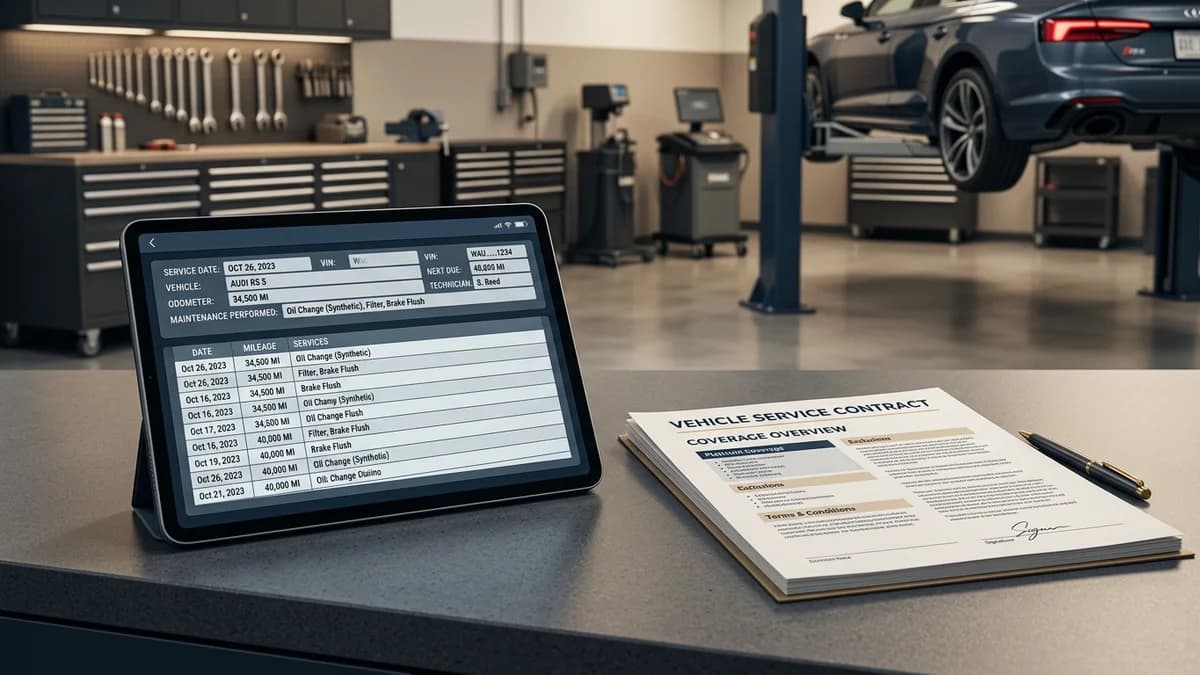
- Date of Service: Clearly stamped to verify the interval.
- Mileage at Service: To demonstrate compliance with the manufacturer’s schedule.
- VIN (Vehicle Identification Number): To ensure the service was performed on the covered vehicle.
- Itemized Description: A list of parts used (e.g., oil type, filter, fluids) and labor performed.
- Facility Information: The name, address, and phone number of the service center.
The Digital Archive Strategy
Transitioning to a digital record-keeping system is the most effective way to protect your coverage. Many modern repair facilities provide digital invoices that can be stored in cloud-based folders. If you perform your own maintenance—which is permitted under most contracts—you must keep detailed logs, receipts for all parts and fluids, and photographs of the service being performed to serve as secondary evidence.
Common Maintenance Pitfalls to Avoid
Even diligent owners can inadvertently invalidate their coverage by overlooking specific nuances in their service schedule. Review our FAQ for more on specific contract exclusions.
Ignoring "Severe" Driving Conditions
Most owner’s manuals provide two maintenance schedules: "Normal" and "Severe." Many drivers operate their vehicles under "Severe" conditions—defined as frequent short trips, extreme temperatures, heavy stop-and-go traffic, or towing—without realizing it. If you operate under these conditions but follow the "Normal" service interval, an administrator may argue that you failed to maintain the vehicle according to the actual usage patterns, potentially leading to a denied claim.
The Fluid Integrity Trap
Engine oil is the most common point of contention, but transmission fluid, coolant, and brake fluid intervals are equally critical. Modern vehicles with complex electronic transmissions are particularly sensitive to fluid degradation. Skipping a scheduled transmission flush can lead to catastrophic internal failure, and because these systems are closely monitored by the vehicle's computer, the lack of maintenance will be immediately apparent to the technician performing the diagnostic.
How Maintenance Affects Your Long-Term Costs
While the primary goal of maintenance is to prevent mechanical failure, it also impacts your overall cost-to-own profile. By keeping your vehicle in peak condition, you reduce the likelihood of needing to use your VSC for repairs that are avoidable.
If you are currently evaluating whether to purchase a VSC or if you are concerned about your current vehicle’s reliability, our pricing-bands tool can help you understand the typical costs associated with your vehicle class. Understanding these costs helps put the price of preventative maintenance into perspective. For example, a $100 oil change is a significantly lower expense than an engine rebuild, even if the latter is covered by a VSC.
Proactive Communication with Your Administrator
If you are unsure about whether a specific service center or a specific type of service meets your contract requirements, the best course of action is to contact your VSC administrator directly. Do not rely on the verbal advice of a service advisor at a dealership.
Questions to Ask Your Administrator:
- Does my contract require OEM (Original Equipment Manufacturer) parts, or are aftermarket parts acceptable?
- Are there specific "severe" service intervals I need to be aware of for my specific vehicle model?
- How should I submit maintenance records if I perform my own fluid changes?
Conclusion: Compliance is Your Best Defense
Maintaining your vehicle is not just about extending its lifespan; it is a contractual obligation that protects your investment in a Vehicle Service Contract. By keeping rigorous, dated, and itemized records of every service performed, you ensure that if a failure does occur, the claims process will be as seamless as possible.
For more information on how different vehicle types and brands influence your maintenance needs and potential VSC costs, we encourage you to browse by brand on our platform. Staying informed is the best way to ensure that your coverage remains as robust as the day you purchased it.