Top 10 Car Repairs by Mileage: A Data-Driven Reliability Guide
A breakdown of the 10 most common vehicle repairs categorized by mileage, helping owners understand when mechanical failure risks typically escalate.
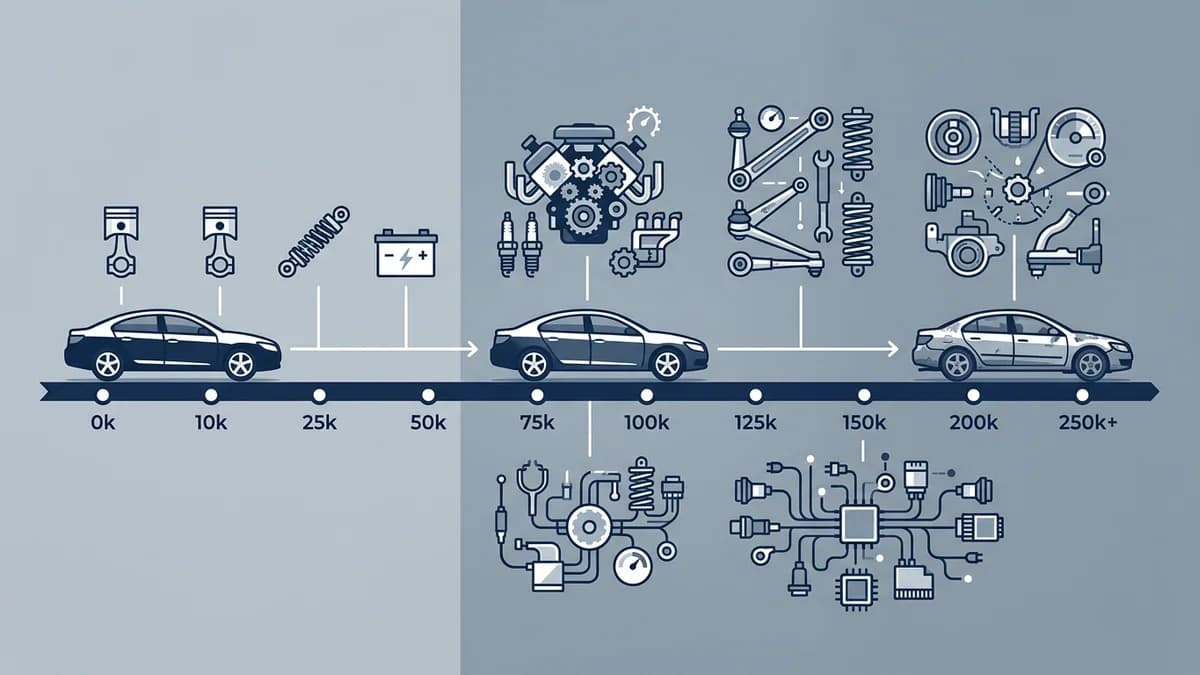
Understanding the Lifecycle of Vehicle Components
Modern vehicles are marvels of engineering, yet they remain subject to the inevitable laws of friction, thermal stress, and material fatigue. As an independent pricing authority, OptimalCover analyzes millions of repair data points to assist consumers in understanding the financial risks associated with vehicle ownership. While some components are designed for the lifespan of the vehicle, others are essentially consumables that fail with predictable regularity as the odometer climbs.
Understanding which repairs to anticipate is the first step in evaluating your need for a Vehicle Service Contract (VSC). By examining the most common repairs by mileage, owners can better navigate the transition from factory warranty coverage to post-warranty ownership.
The Early Years: 0–50,000 Miles
In the first 50,000 miles, most vehicles are protected by the manufacturer’s original powertrain and bumper-to-bumper warranties. However, non-warranty items or secondary systems may begin to show signs of wear.
1. Oxygen Sensors
Often triggered by fuel combustion variances, oxygen sensors are among the most frequent sensor replacements. While simple to replace, they can cause a vehicle to fail emissions testing and decrease fuel efficiency.
2. Battery Replacements
While typically considered maintenance, modern vehicles with sophisticated start-stop technology place significant strain on batteries. In extreme climates, these often reach their end-of-life before the 50,000-mile mark.
The Mid-Life Threshold: 50,000–100,000 Miles
This is the period where the financial burden of maintenance shifts entirely to the owner. It is also the sweet spot where pricing bands for VSCs begin to reflect the increased risk of mechanical failure.
3. Suspension Components (Struts and Shocks)
Road conditions dictate the lifespan of a suspension system. By 75,000 miles, dampers often lose their ability to control spring oscillation, leading to uneven tire wear and degraded handling.
4. Ignition Coils and Spark Plugs
Modern direct-injection engines are demanding. Worn spark plugs can lead to ignition coil failure, causing engine misfires. This repair is a classic example of a "cascading" failure where one neglected component damages a more expensive electronic part.
5. Water Pumps and Thermostats
Cooling system integrity is vital. The water pump, often driven by the timing belt or serpentine belt, frequently begins to leak or seize between 80,000 and 100,000 miles. A failure here can lead to catastrophic engine overheating.
The High-Mileage Era: 100,000+ Miles
Once a vehicle crosses the 100,000-mile threshold, the frequency and cost of repairs typically increase. For those browsing coverage options, this is the stage where exclusionary coverage becomes most relevant.
6. Alternators
As electrical components age, the internal brushes and voltage regulators within an alternator wear out. This is a common failure point that leaves owners stranded without warning.
7. Fuel Pumps
The fuel pump resides inside the fuel tank, making it a labor-intensive repair. At high mileage, the pump motor simply reaches its cycle limit.
8. Transmission Solenoids and Valve Bodies
Modern automatic transmissions are controlled by complex electronic solenoids. As transmission fluid degrades, these solenoids can stick or fail, resulting in harsh shifting or gear engagement issues.
9. Catalytic Converters
Often the result of long-term engine performance issues or simply the degradation of precious metals within the unit, catalytic converter replacement is one of the most expensive "common" repairs.
10. AC Compressor Failures
The air conditioning system is a pressurized loop. After a decade or 100,000 miles of use, seals often fail, or the compressor clutch wears out, requiring a full system evacuation and component replacement.
How to Use This Data for Financial Planning
Understanding these failure points is critical when assessing whether a VSC provides value for your specific vehicle. Our methodology accounts for these repair frequencies when establishing fair pricing ranges for various vehicle classes.
- Risk Assessment: Does your vehicle have a history of specific sensor or cooling system issues? Use our FAQ section to understand how coverage handles these specific component groups.
- Budgeting: By anticipating the cost of a high-mileage repair (e.g., an alternator or a transmission valve body), you can determine if a fixed-cost VSC is a better financial hedge than self-insuring.
Conclusion
Vehicle reliability is not a static metric; it is a trajectory. By understanding the typical failure timeline of your vehicle, you can make informed decisions about when to retain a warranty, when to perform preventative maintenance, and how to allocate your automotive budget. For more insights on how vehicle age and mileage impact total cost of ownership, consult our data-driven pricing resources.